Những kết quả đột phá
(Tham khảo từ bài nghiên cứu Krauss (2024) )
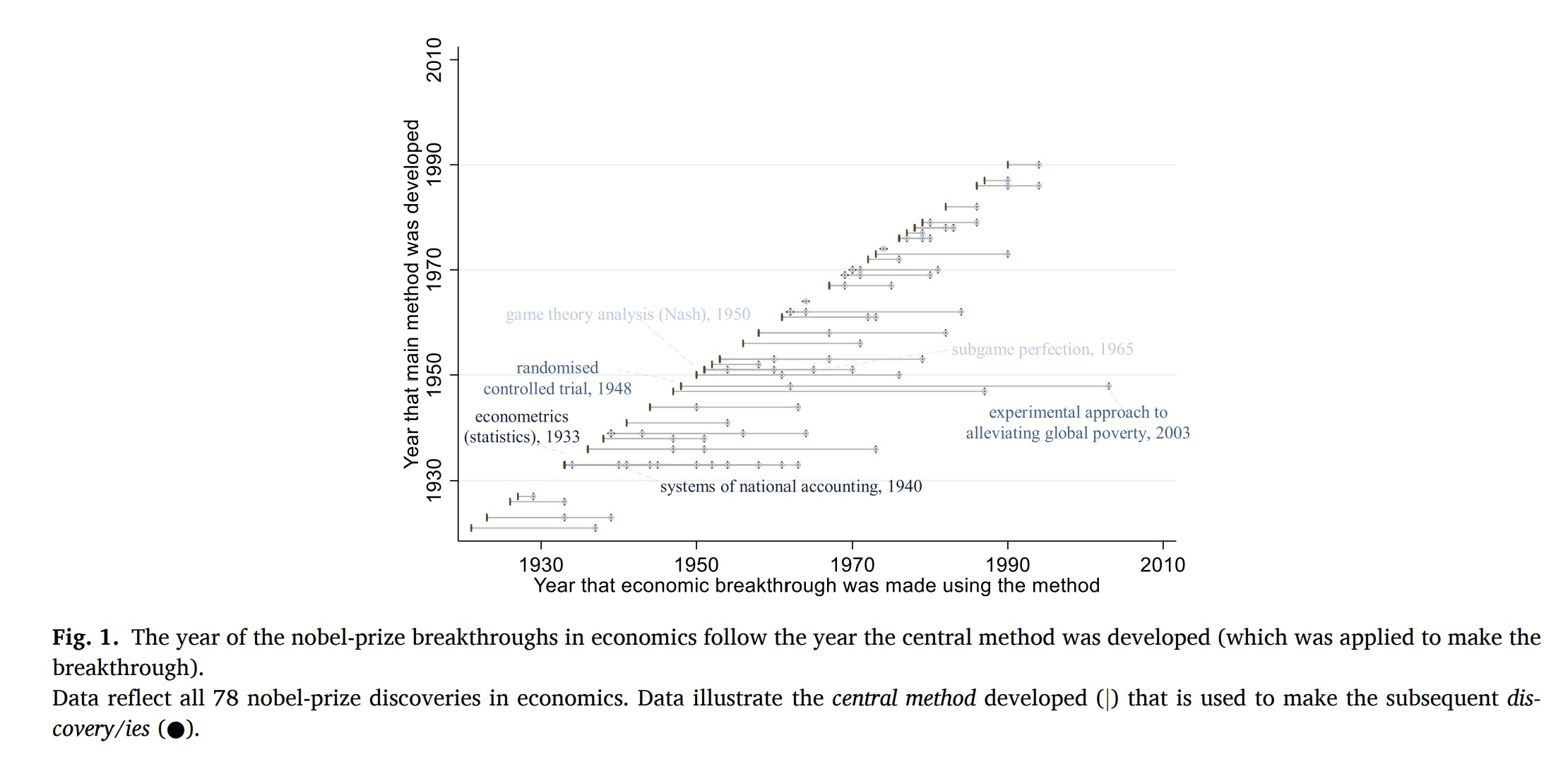
- Krauss (2024) đề cập đến những giải Nobel từ năm 1969 (năm đầu tiên giải thưởng được trao) đến năm 2022 (Giải Nobel năm 2023) với 78 phát hiện đoạt giải Nobel kinh tế, được thực hiện bởi 92 nhà kinh tế đã được trao giải Nobe trong giai đoạn này.
Hình 01 - Biểu đồ giữa năm phương pháp nghiên cứu được giới thiệu và năm đạt giải Nobel
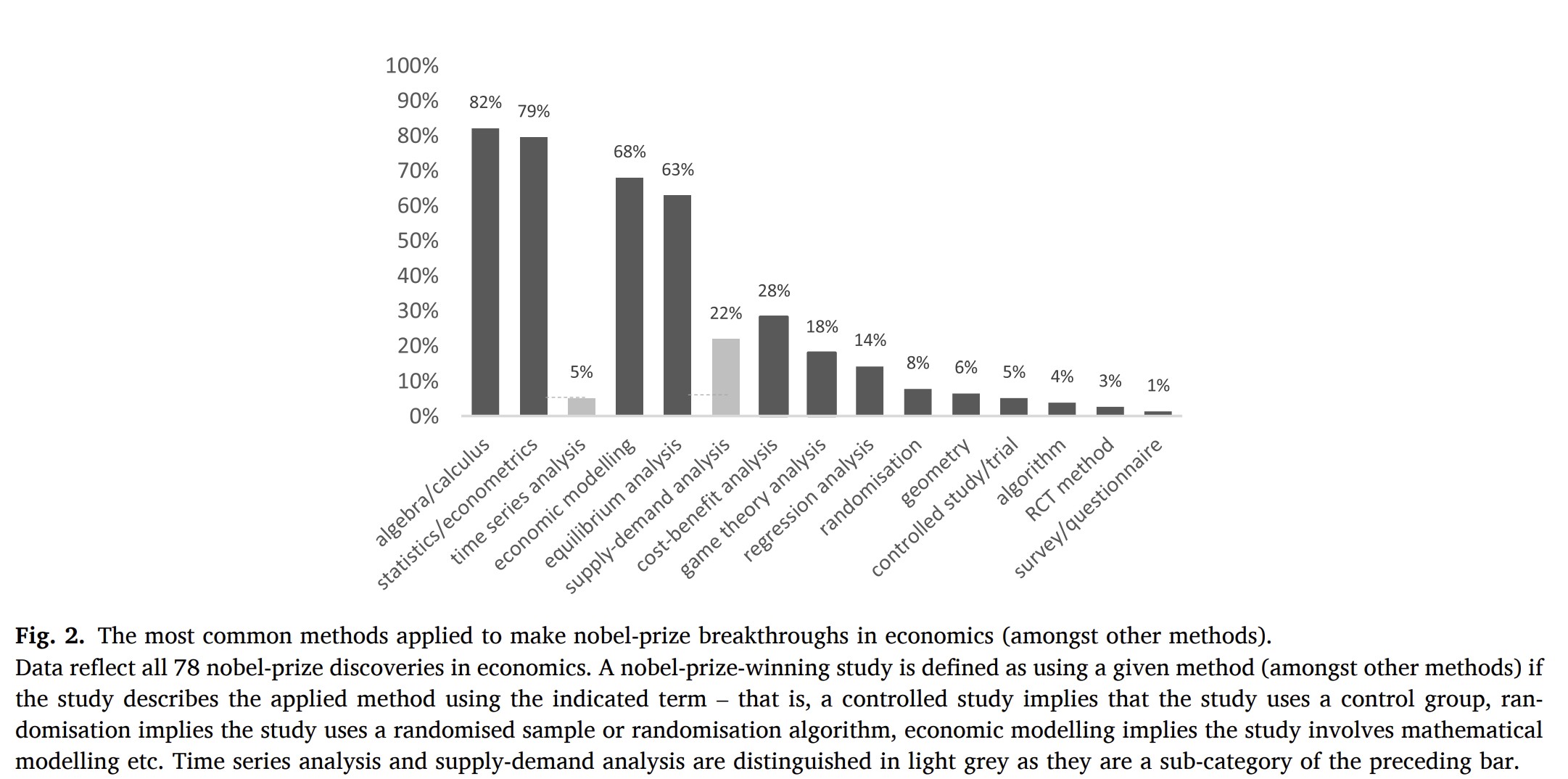
Hình 02 - Các phương pháp phổ biến nhất được áp dụng để tạo nên những đột phá đoạt giải Nobel trong kinh tế học
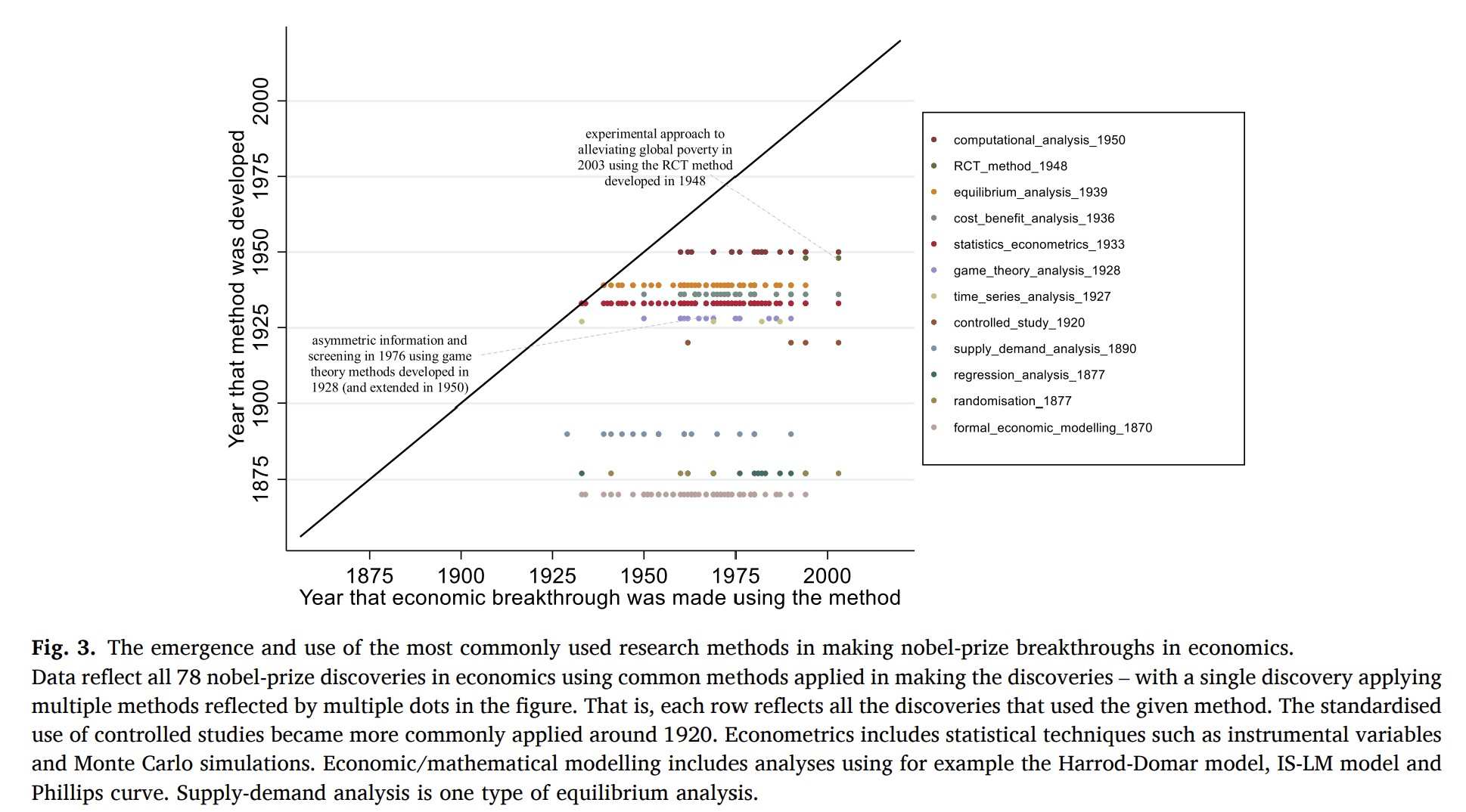
Hình 03 - Sự xuất hiện và việc sử dụng các phương pháp nghiên cứu phổ biến nhất trong việc tạo ra những đột phá đoạt giải Nobel kinh tế.
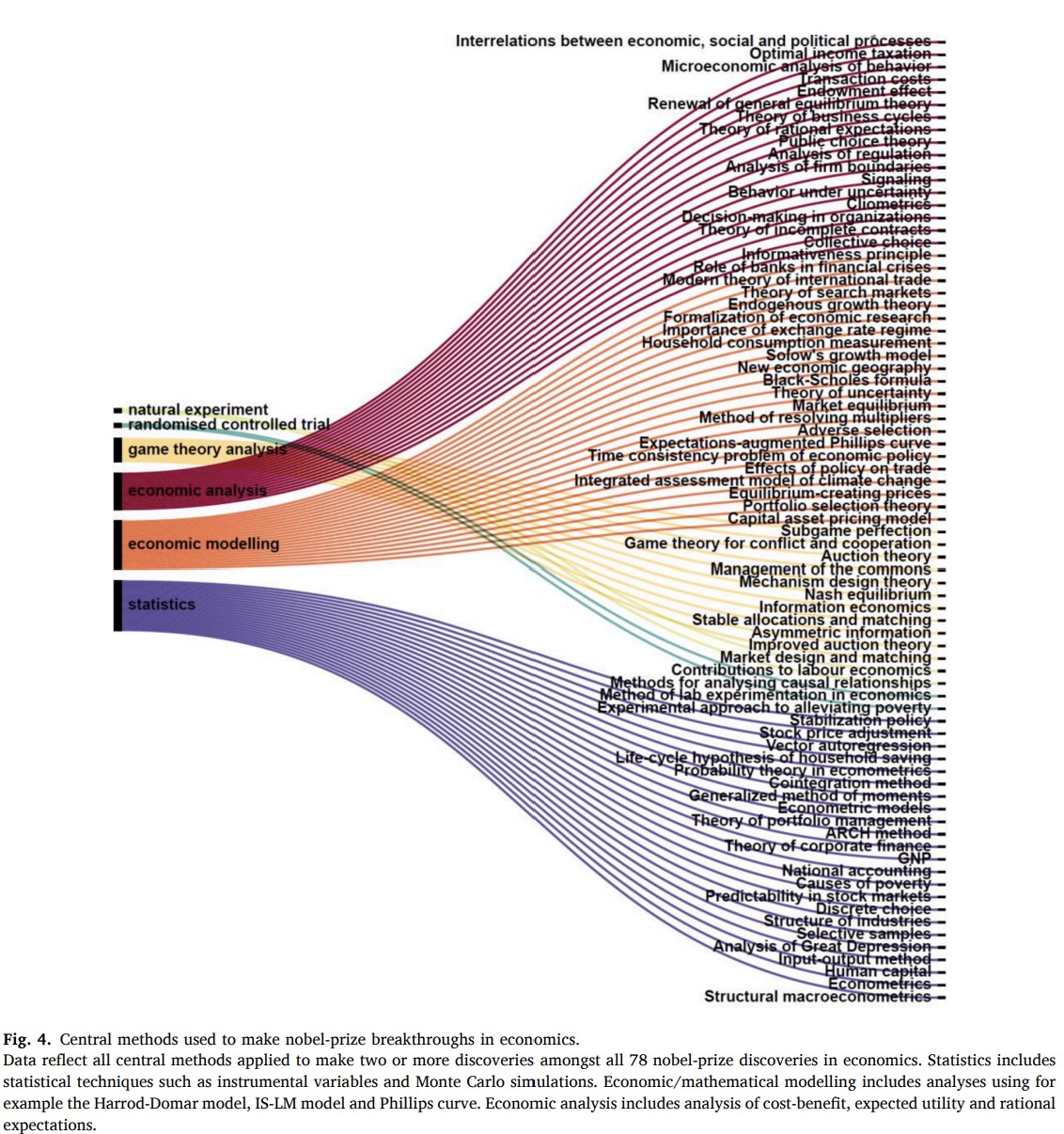
Hình 04 - Các phương pháp trọng tâm được sử dụng để tạo nên những đột phá đoạt giải Nobel trong kinh tế học.
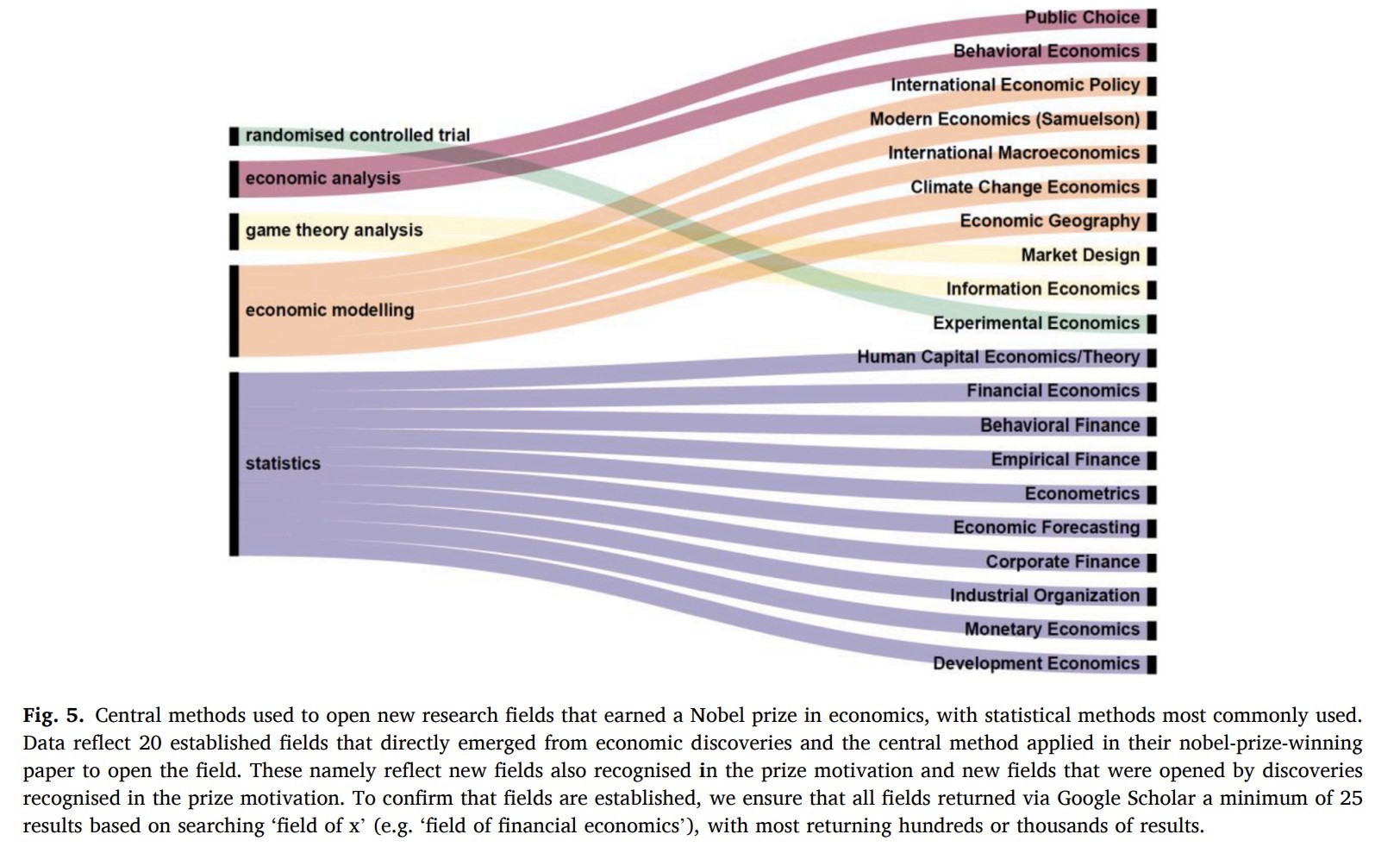
Hình 05 - Các phương pháp trọng tâm được sử dụng để mở ra các lĩnh vực nghiên cứu mới, giúp giành được giải Nobel kinh tế, trong đó phương pháp thống kê được sử dụng phổ biến nhất.
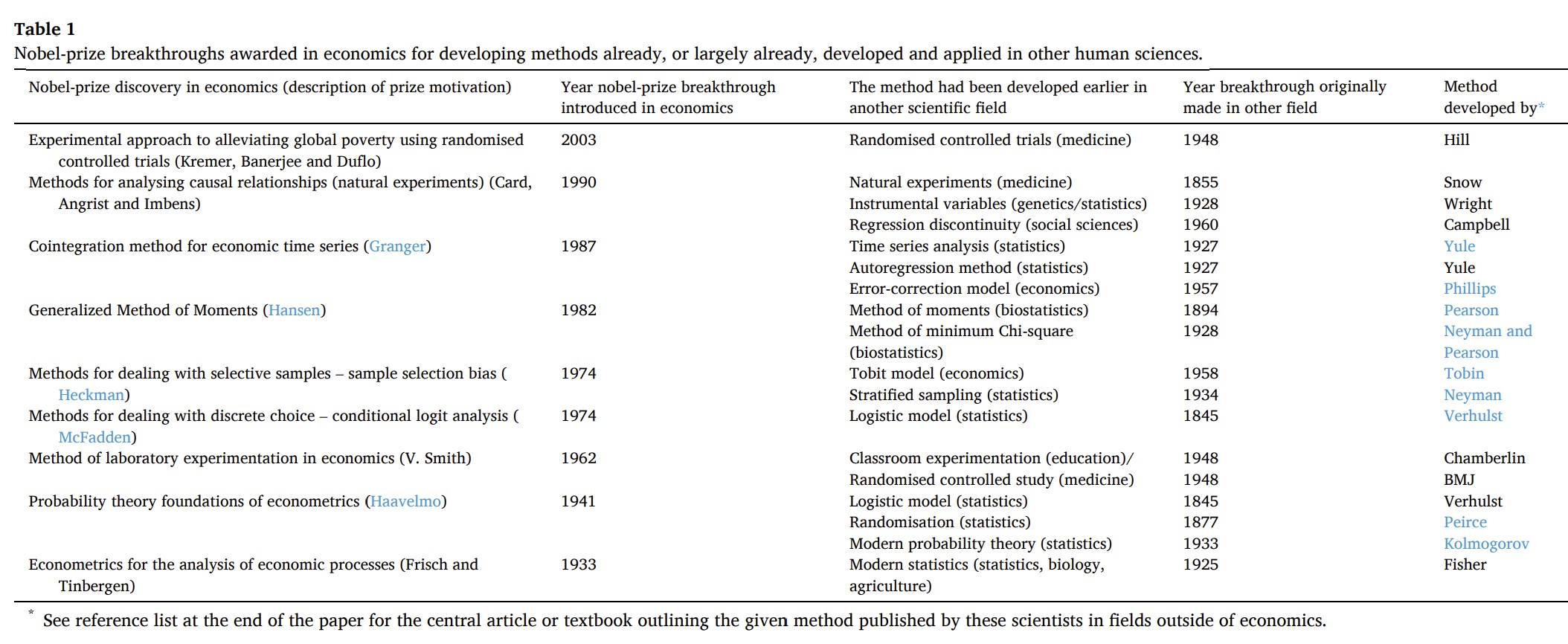
Bảng 1 - Các phương pháp trọng tâm được sử dụng để mở ra các lĩnh vực nghiên cứu mới, giúp giành được giải Nobel kinh tế, trong đó phương pháp thống kê được sử dụng phổ biến nhất.
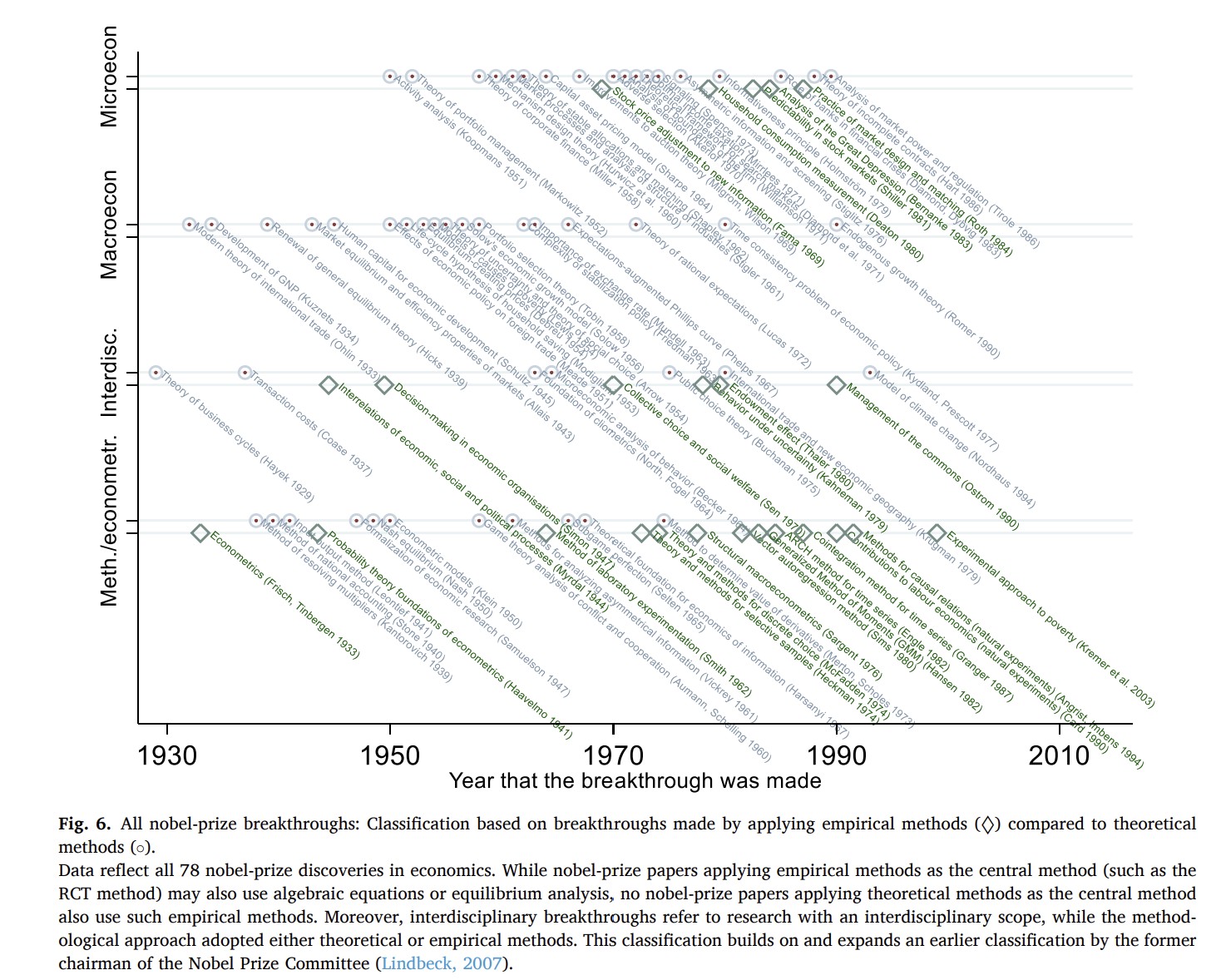
Hình 06 - Các phương pháp trọng tâm được sử dụng để mở ra các lĩnh vực nghiên cứu mới, giúp giành được giải Nobel kinh tế, trong đó phương pháp thống kê được sử dụng phổ biến nhất.
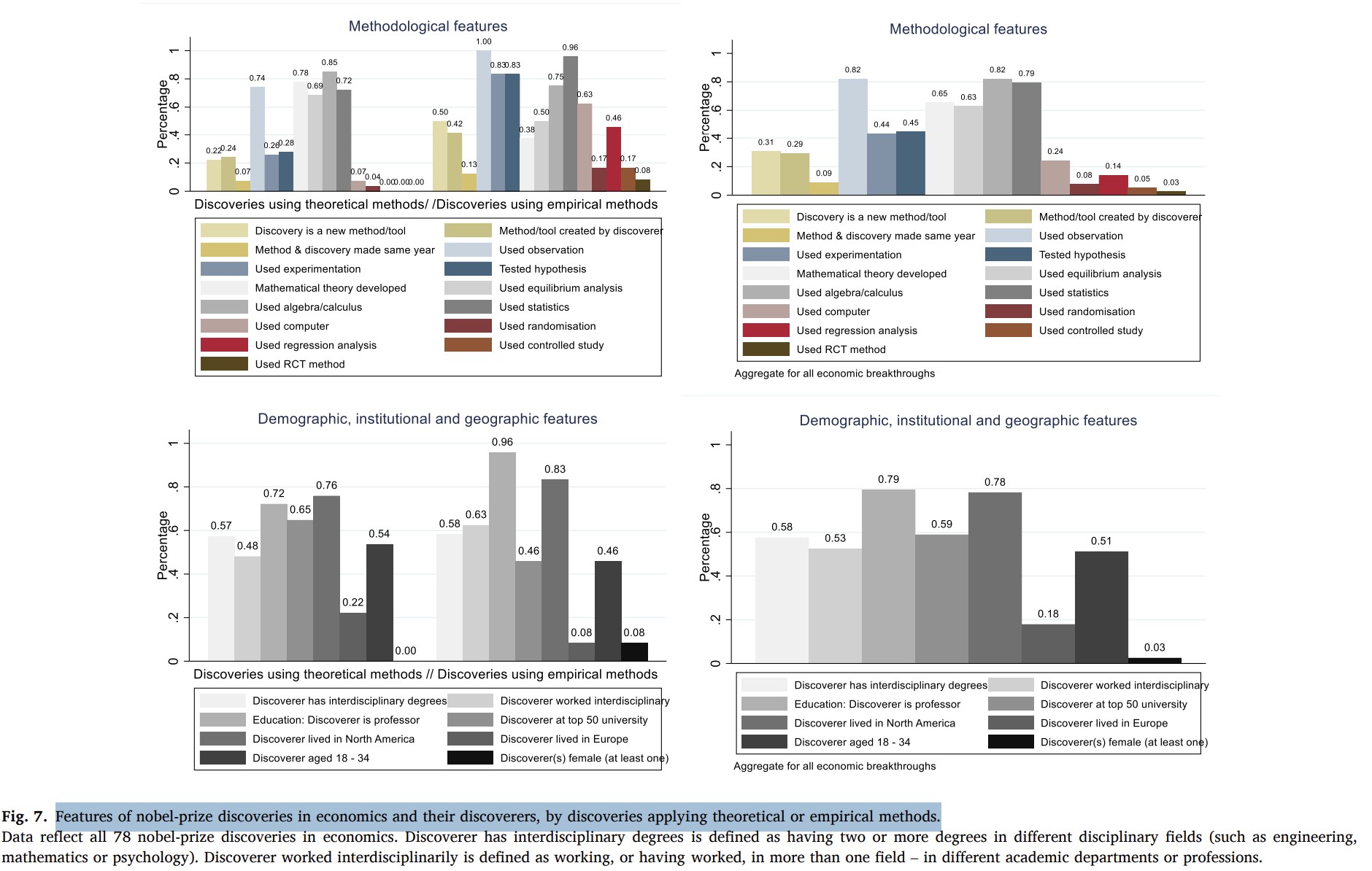
Hình 07 - Đặc điểm của những phát hiện đoạt giải Nobel trong lĩnh vực kinh tế và những người phát hiện ra chúng, dựa trên việc áp dụng các phương pháp lý thuyết hoặc thực nghiệm.
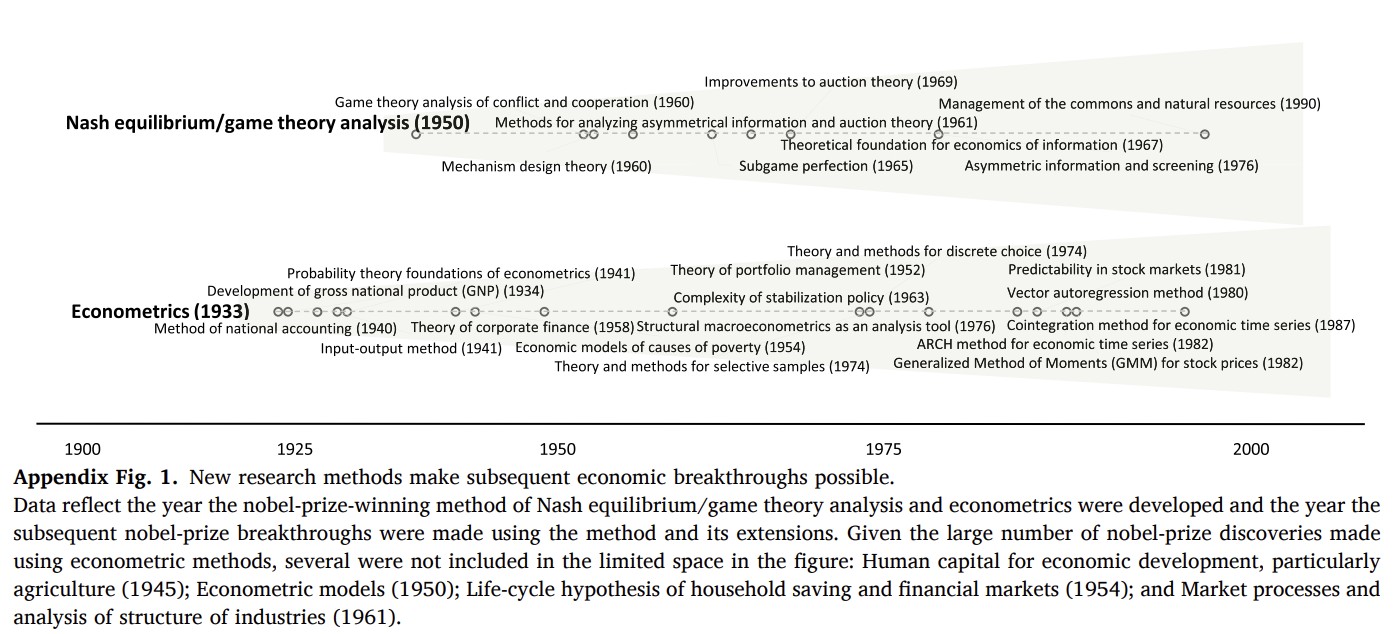
Appendix Fig. 1 - New research methods make subsequent economic breakthroughs possible.
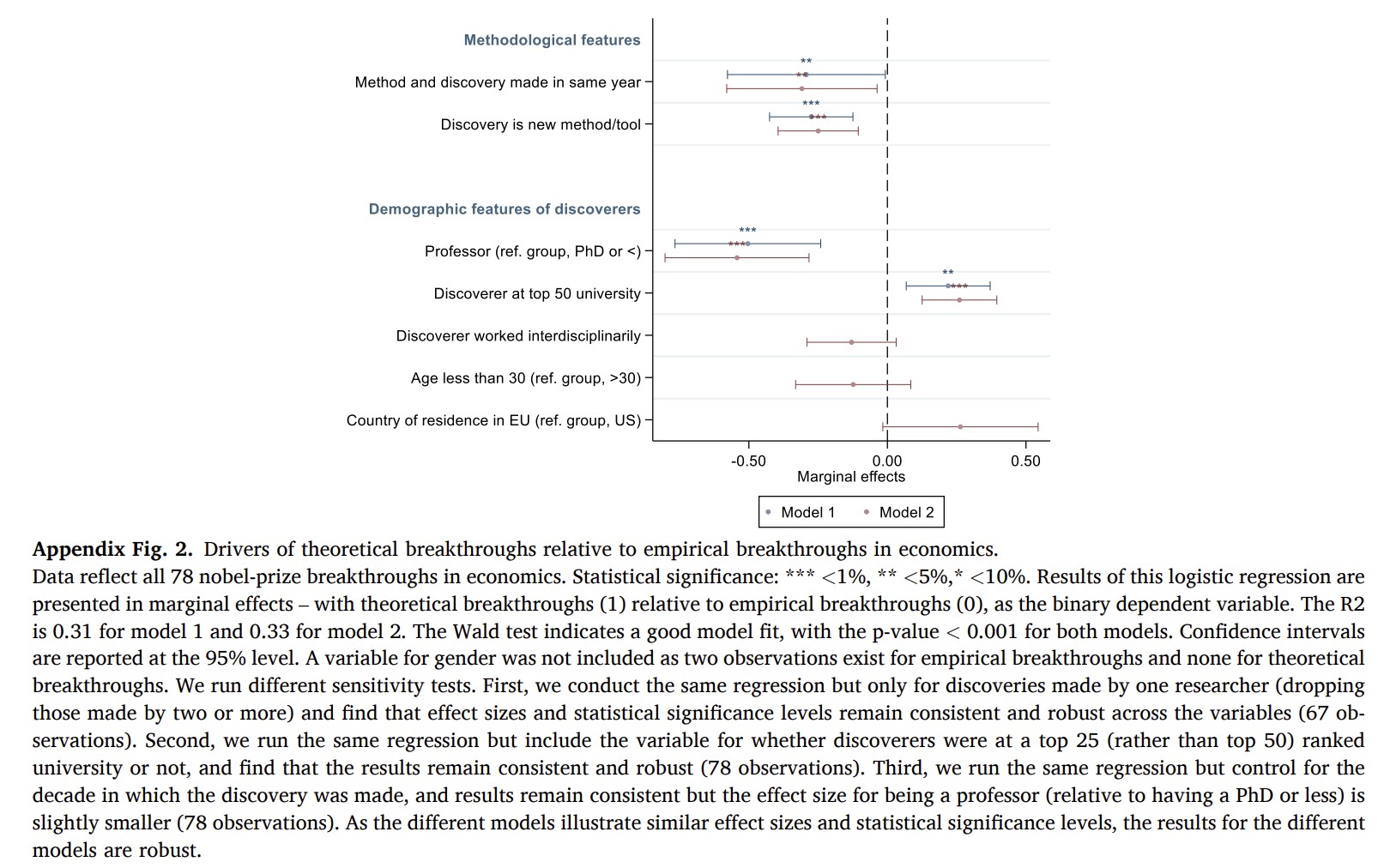
Appendix Fig. 2 - Drivers of theoretical breakthroughs relative to empirical breakthroughs in economics.
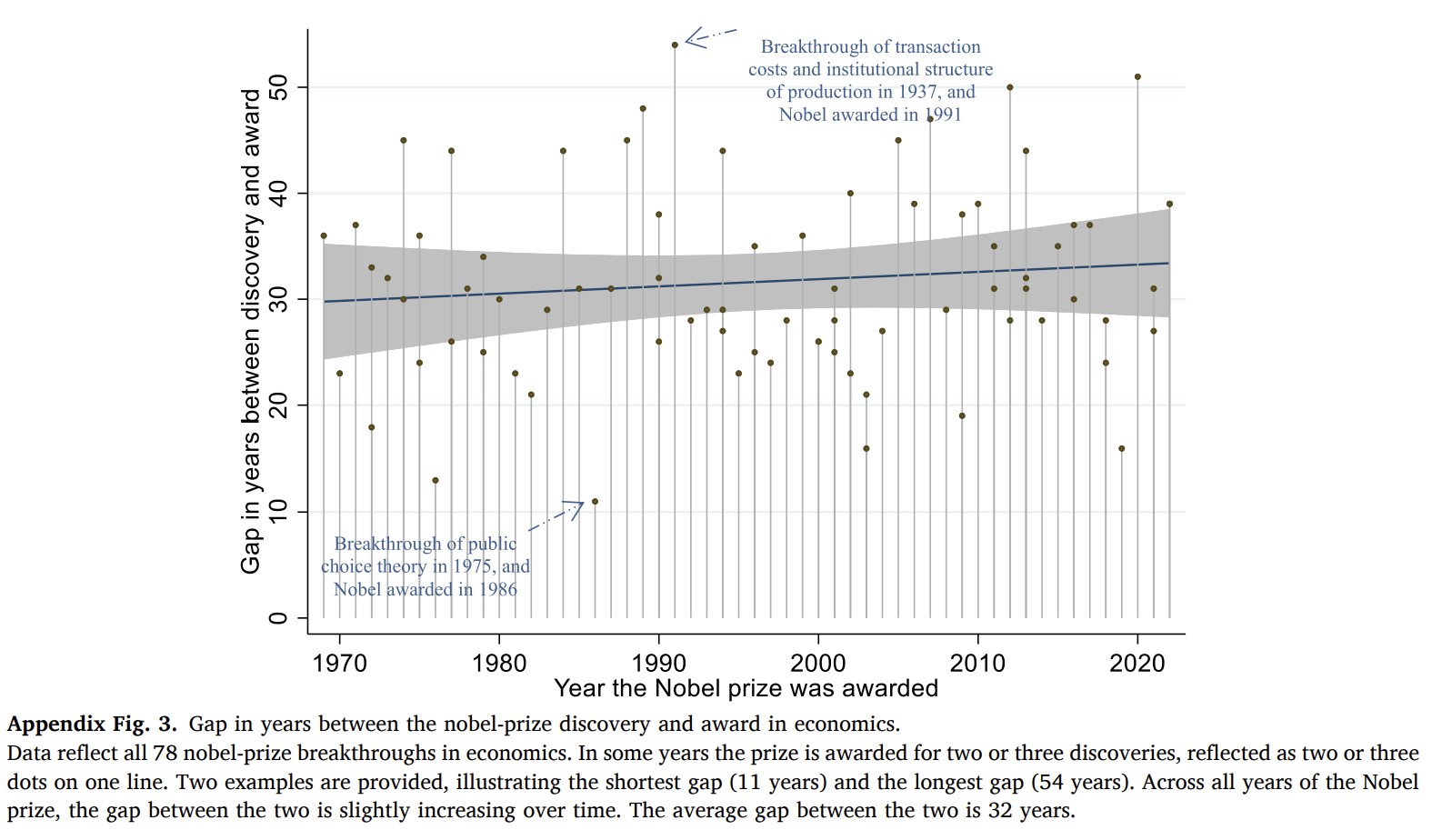
Appendix Fig. 3 - Gap in years between the nobel-prize discovery and award in economics.
Tài liệu tham khảo
- Krauss, A. (2024). How nobel-prize breakthroughs in economics emerge and the field’s influential empirical methods. Journal of Economic Behavior & Organization, 221, 657-674.
- Engle, RF., Granger, C.W.J., 1987. Co-integration and error correction: representation, estimation, and testing. Econometrica 55 (2), 251–276.
- Fisher, R.A., 1925. Statistical Methods for Research Workers. Oliver & Boyd, Edinburgh.
- Frey, B.S., Gallus, J., 2017. Towards an economics of awards. J. Econ. Surv. 31, 190–200.
- Frisch, R., Waugh, FV., 1933. Partial time regressions as compared with individual trends. Econometrica 1 (4), 387–401.
- Haavelmo, T., 1944. The probability approach in econometrics. Econometrica 12, 115 iii.
- Hansen, L.P., 1982. Large sample properties of generalized method of moments estimators. Econometrica 50, 1029–1054.
- Heckman, JJ., 1974. Effects of child-care programs on women’s work effort. J. Political Econ. 82 (2), S136–S163.
- Imbens, G.W., Angrist, J.D., 1994. Identification and estimation of local average treatment effects. Econometrica 62 (2), 467–475.
- Jones, B., 2009. The burden of knowledge and the “death of the renaissance man”: is innovation getting harder? Rev. Econ. Stud. 76 (1), 283–317.
- Karier, T., 2011. Intellectual Capital: Forty Years of the Nobel Prize in Economics. Cambridge University Press, New York.
- Kolmogorov, A., 1933. Foundations of the Theory of Probability. Chelsea publishing, New York reprinted 1956.
- Krauss, A., Danús, L., Sales-Pardo, M., 2023. Early-career factors largely determine the future impact of prominent researchers: evidence across eight scientific fields. Nat. Sci. Rep. 13, 18794.
- Krauss, A., 2024a. Science’s greatest discoverers: a shift towards greater interdisciplinarity, top universities and older age. Nat. Hum. Soc. Sci. Commun. 11, 272.
- Krauss, A., 2024b. Redefining the Scientific method: As the Use of Sophisticated Scientific Methods That Extend Our Mind. PNAS Nexus.
- Kremer, M., 2003. Randomized evaluations of educational programs in developing countries: some lessons. Am. Econ. Rev. 93 (2), 102–106.
- LaLonde, R.J., 1986. Evaluating the econometric evaluations of training programs using experimental data. Am. Econ. Rev. 76, 602–620.
- Lerner, K. Lee; Brenda Lerner (Eds), 2004. Gale Encyclopedia of Science, Third Edition. Thomson/Gale.
- Lindbeck, A., 2007. The Sveriges Riksbank Prize in Economic Sciences in Memory of Alfred Nobel 1969-2007. Nobel Prize in Economics Documents, Nobel Prize Committee first edition 1999.
- McCabe, M.; Babutsidze, Z. 2020. Scientific prizes and post-award attention: evidence from the nobel prize in economics. Boston University Questrom School of Business Research Paper No. 3534922.
- McFadden, D., 1974. Conditional logit analysis of qualitative choice behavior. In: Zarembka, P (Ed.), Frontiers Ineconometrics. Academic Press, New York, pp. 105–142.
- Montelpare, William, Read, Emily, McComber, Teri, Mahar, Alyson, Ritchie, Krista, 2021. John Snow and the Natural Experiment. Applied Statistics in Healthcare Research. Pressbooks, Montreal.
- Neyman, J., Pearson, E.S., 1928. On the use and interpretation of certain test criteria for purposes of statistical inference: part I. Biometrika 20A, 175–240.
- Neyman, J., 1934. On the two different aspects of the representative method: the method of stratified sampling and the method of purposive selection. J. R. Statist. Soc. 97 (4), 558–625.
- Nobel Prize, 1970. Paul Samuelson - Facts. Nobel Media. https://www.nobelprize.org/prizes/economic-sciences/1970/samuelson/facts/.
- Nobel Prize, 2021. Scientific Background: Answering Causal Questions Using Observational Data. Nobel Prize. https://www.nobelprize.org/uploads/2021/10/ advanced-economicsciencesprize2021.pdf.
- Nobel Prize, 2023. Nobel Prize. Nobel Media AB. www.nobelprize.org.
- Nordhaus, W., 1994. Managing the Global Commons: The Economics of Climate Change. MIT Press, Cambridge, MA.
- Oakes, Elizabeth., 2007. Encyclopedia of World Scientists. Infobase Publishing, New York. Revised Edition.
- Offer, A., Soderberg, ¨ G., 2016. The Nobel Factor: The Prize in Economics, Social Democracy, and the Market Turn. Princeton University Press, Princeton.
- Pearson, K., 1894. Contributions to the mathematical theory of evolution. Philos. Trans. R. Soc. Lond. A 185, 71–110.
- Peirce, CS., 1877. In: Illustrations of the logic of science. The Popular Science Monthly, Nov.
- Phillips, A., 1957. Stabilization policy and the time forms of lagged responses. Econ. J. 67, 265–277.
- Reschke, BP., Azoulay, P., Stuart, TE., 2017. Status spillovers: the effect of status-conferring prizes on the allocation of attention. Adm. Sci. Q. 63 (4), 819–847.
- Romer, PM., 1990. Endogenous technological change. J. Political Econ. 98 (5), S71–102.
- Samuelson, Paul, 1947. Foundations of economic analysis. Oxford University Press, Bombay.
- Sanderson, A., Siegfried, J., 2019. The nobel prize in economics turns 50. Am. Econ. 64 (2), 167–182.
- Schultz, Theodore W., 1945. Agriculture in an unstable economy. McGraw-Hill Book Company, New York.
- Schumpeter, J., 1939. Business Cycles: A Theoretical, Historical, and Statistical Analysis of the Capitalist Process. McGraw Hill, New York and London.
- Schumpeter, J., 2008. Capitalism, Socialism and Democracy, 3d ed. Harper, New York.
- Sherby, L., 2002. The Who’s Who of Nobel Prize Winners 1901-2000. Oryx Press, London.
- Simonis, Doris (Ed.), 1999. Lives and Legacies: An Encyclopedia of People Who Changed the World Scientists, Mathematicians, and Inventors. The Oryx Press, Phoenix.
- Smith, VL., 1962. An experimental study of competitive market behavior. J. Political Econ. 70 (2), 111–137.
- Solow, RM., 1957. Technical change and the aggregate production function. Rev. Econ. Stat. 39 (3), 312–320.
- Stephan, Paula, 1996. The Economics of Science. Journal of Economic Literature; 34 (3), 1199–1235.
- Stephan, Paula, 2015. How Economics Shapes Science. Harvard University Press, Cambridge, MA.
- Thaler, R.H., 1980. Toward a Positive Theory of Consumer Choice. Journal of Economic Behavior and Organization 1, 39–60.
- Thistlewaite, D.L., Campbell, D.T., 1960. Regression-discontinuity analysis: an alternative to the ex post facto experiment. J. Educ. Psychol. 51 (6), 309–317.
- Tobin, J., 1958. Estimation of relationships for limited dependent variables. Econometrica 26 (1), 24–36.
- US Department of Health and Human Services, 1983. Final Report of the Seattle-Denver Income Maintenance Experiment. Government Printing Office, Washington
- Verhulst, P., 1845. Recherches mathematiques sur la loi d’accroissement de la population. Mem. Acad. R. Belg. 18, 1–38.
- von Hayek, F., 1929. Monetary Theory and the Trade Cycle. Jonathan Cape, London translation in 1933.
- Wright, PG., 1928. The Tariff on Animal and Vegetable Oils. MacMillan, New York.
- Wuchty, S., Jones, B., Uzzi, B., 2007. The increasing dominance of teams in production of knowledge. Science; 316, 1036–1039.
- Yule, U., 1927. On a method of investigating periodicities disturbed series, with special reference to Wolfer’s sunspot numbers. Philosoph. Trans. R. Soc. Lond. A 226, 267–298.